Music & Well-Being

How does active music making
affect our daily lives?

How does active music-making affect our daily lives?

In this study at the University of Innsbruck, our goal is to understand how people experience active music-making in their daily lives.
Specifically, we are interested in what motivates people to make music and how it affects their mood and well-being while playing and afterward.


🔎
Study Procedure

1. Baseline-Questionnaire (once)
  • Duration: ~15 minutes
  • Topics: demographics, musical habits and attitudes, personality
  • At the end, you will be asked for your email address to register for the daily surveys in the second phase. Your email will be used only for this purpose and deleted afterward.
  • Note: The questionnaire can be completed on a smartphone, but using a computer or laptop is usually easier.
2. Experience-Sampling-Phase (14 days)
  • Each evening, you will answer short questions in the SEMA³ app about your daily experiences and music-making (~2–3 minutes).
  • On both Sundays of the study, you will also complete a short weekly questionnaire about your musical experiences over the past week (~5–7 minutes).
  • For this phase, you will need a smartphone (iOS or Android).

💡
Participation Requirements

  • Regular, active engagement in music (playing an instrument, singing, composing, etc., at least once per week)
  • Minimum age: 16

🎁
What’s in for you?

  • Entry into a raffle for two tickets to exclusive classical concerts
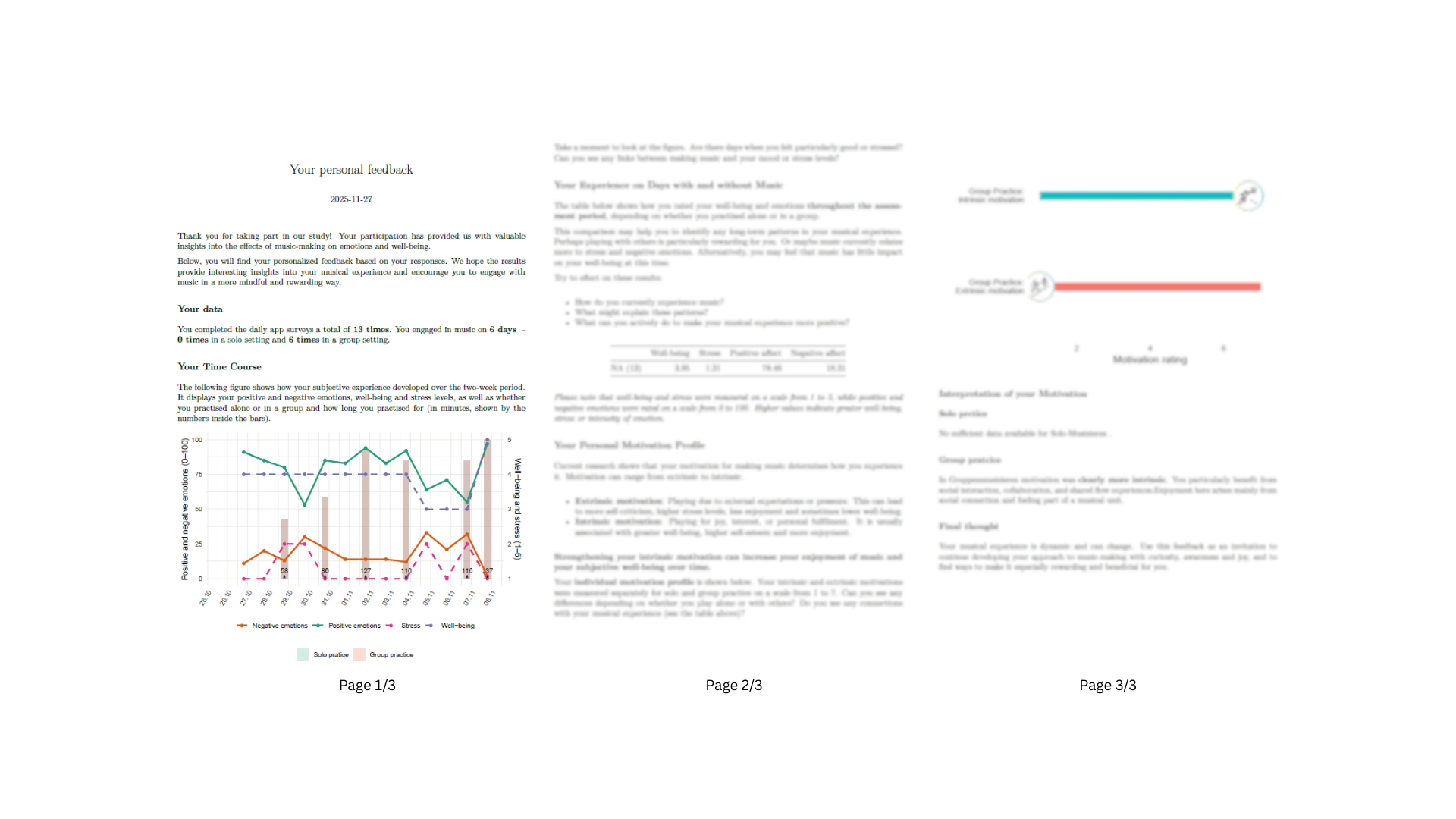
  • Optional: personalized feedback report with your individual results
  • 3 course credits for psychology students at the University of Innsbruck upon full participation

🔒
Data Protection

  • Participation is voluntary. You will be asked to give informed consent before taking part. Data will be used only for scientific publications.
  • You may withdraw at any time, for any reason, with no disadvantages.
  • All responses are stored anonymously on secure university servers, accessible only to our research team.
  • This project complies with all data protection and ethical standards.